
Introduction
A screw-down crown helps a dive watch maintain its water resistance by pressing the crown firmly against its sealing system when fully tightened. This is especially important for watches designed for swimming, diving, and other environments where water pressure can challenge the case.
For watch brands developing a dive watch, however, the crown is more than a visual detail. Its construction, gasket design, tube, threading, and tolerances all affect reliability, usability, and production cost. Understanding these factors before working with a watch manufacturer can help buyers choose the right specification for their product.
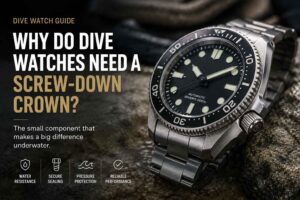
How Does a Screw-Down Crown Work?
Answer: A screw-down crown uses a threaded crown and case tube to create a tighter connection between the crown and the watch case, while gaskets provide the primary sealing function.
The Crown Screws Into the Case Tube
Unlike a standard push-in crown, a screw-down crown has internal threads that engage with matching threads on a tube attached to the watch case.
When the crown is screwed down completely, it is held firmly against the sealing surfaces. This reduces the chance of the crown being accidentally pulled or left in an open position.
Gaskets Create the Water Seal
The threads themselves are not the only reason a dive watch is water resistant.
Gaskets, commonly made from rubber or synthetic sealing materials, create the actual barrier against water. Their dimensions, material, compression, and positioning all influence sealing performance.
A properly designed crown system typically includes sealing points around the crown stem and crown/tube interface.
Why the Crown Must Be Fully Tightened
A screw-down crown only provides its intended protection when it is correctly closed.
If the crown is not fully engaged, the sealing system may not perform as designed. This is why user instructions and production QC are important for any water-resistant watch.
Key Takeaway: A screw-down crown works as part of a complete sealing system. The threads secure the crown, while properly designed gaskets provide the critical water barrier.
Why Are Screw-Down Crowns Important for Dive Watches?
Answer: Dive watches face greater exposure to water pressure, so the crown needs to reduce one of the potential entry points into the case.
The Crown Is a Potential Weak Point
A watch case may appear completely sealed, but the crown requires a moving stem to connect the external crown with the movement inside.
This creates a more complicated sealing challenge than a fixed case component.
For this reason, professional dive-watch construction pays particular attention to the crown, tube, gaskets, case back, crystal, and other interfaces.
Water Resistance Changes With Pressure
Water pressure increases as depth increases.
A watch rated at 100 meters is not automatically intended for recreational diving to 100 meters. Water-resistance ratings are laboratory specifications and should not be interpreted simply as equivalent usable diving depth.
For watches marketed specifically as professional dive watches, manufacturers may design and test the watch according to ISO 6425 requirements.
Crown Design Supports Overall Case Protection
A screw-down crown does not independently determine whether a watch achieves 100M, 200M, or 300M water resistance.
The final rating depends on the complete case construction, including:
- Crown and tube
- Gaskets
- Case back
- Crystal and crystal gasket
- Case machining
- Assembly tolerances
- Pressure testing
Key Takeaway: The screw-down crown strengthens one of the most critical sealing areas, but water resistance is always a system-level specification.
Screw-Down Crown vs Standard Crown: Which Is Better?
Answer: A screw-down crown is generally more suitable for higher water-resistance watches, while a standard crown can be sufficient for everyday watches with lower water-resistance requirements.
| Feature | Screw-Down Crown | Standard Push-In Crown |
|---|---|---|
| Crown Construction | Threaded | Push-in |
| Sealing System | Crown + tube + gaskets | Primarily gasket-based |
| Typical Application | Dive, sports, high water resistance | Dress, field, everyday watches |
| 100M+ Water Resistance | Common choice | Less common |
| Accidental Crown Movement | Lower when fully locked | Higher |
| Ease of Operation | Requires unscrewing | Faster access |
| User Convenience | Lower | Higher |
| Manufacturing Complexity | Higher | Lower |
| Component Cost | Generally higher | Generally lower |
| Best Use | Dive and tool watches | Everyday and dress watches |
For a brand developing an oem odm watch, the choice should be based on the intended product specification rather than simply adding a screw-down crown for marketing purposes.
What Should Watch Brands Consider When Developing a Screw-Down Crown?
Answer: Crown dimensions, threading, gasket design, case geometry, movement compatibility, and testing requirements should be considered together during product development.
Crown Size and Ergonomics
A larger crown may provide better grip, especially when the watch is used with gloves or in wet conditions.
However, excessive crown size can affect wrist comfort and may interfere with the case design. For many sports and dive watches, crown guards are also used to protect the crown from impact.
Thread and Gasket Tolerances
Thread quality matters.
Poorly machined threads can make the crown difficult to operate or create inconsistent engagement. Gaskets also need appropriate compression. Too little compression may compromise sealing, while excessive compression can make the crown difficult to operate and accelerate gasket wear.
This is one area where an experienced custom watch manufacturer can identify potential problems during sampling.
Movement and Case Compatibility
The crown stem must be compatible with the selected movement and case thickness.
Changing the movement after the case has been developed can affect stem length, crown position, dial height, and overall assembly.
For this reason, movement selection should happen early in the OEM development process.
Key Takeaway: A reliable screw-down crown begins with correct engineering—not simply choosing a crown from a component catalog.
How Is a Screw-Down Crown Tested?
Answer: Water resistance should be verified through controlled testing after the watch has been properly assembled, rather than assumed from the crown specification alone.
Pressure Testing
Depending on the target specification, manufacturers can use water-pressure or air-pressure testing equipment to identify potential leakage.
For a watch intended to achieve 100M, 200M, or higher water resistance, the test procedure should match the agreed product specification.
Testing After Assembly Matters
A crown may perform correctly as an individual component but still fail when integrated into the finished watch.
Assembly tolerances, gasket placement, case-back sealing, crystal installation, and stem alignment can all influence the final result.
This is why an OEM watch supplier should verify water resistance at appropriate stages of production.
Sample Testing Before Mass Production
For a new custom dive watch, testing the approved prototype before mass production is particularly important.
If the prototype fails, the engineering team can investigate the crown, gasket, case, crystal, or assembly process before hundreds or thousands of units are produced.
Key Takeaway: Water resistance should be tested on the complete assembled watch, not inferred from the crown design alone.
Common Mistakes Buyers Should Avoid
Choosing a Screw-Down Crown Without a Clear Water-Resistance Target
Adding a screw-down crown increases component and assembly complexity.
If the watch is only intended for everyday use with moderate water resistance, the additional complexity may not provide enough practical value.
Treating Water Resistance Ratings as Diving Depth
A “200M” marking should not automatically be interpreted as safe diving to 200 meters.
Brands should clearly define the intended use and select the appropriate testing and specification requirements.
Ignoring Crown Operation
A technically strong crown can still create a poor user experience if it is too small, difficult to grip, or difficult to screw into position.
For a custom logo watch or branded dive collection, ergonomics should be considered alongside visual design.
Testing Only the Crown Component
The crown is one part of the sealing system.
The complete watch should be tested after assembly to verify that the specified water-resistance performance is actually achieved.
Expert Advice from Hongliyuan Watch
From an OEM manufacturing perspective, we recommend that brands define the intended water-resistance level before finalizing the crown design.
A practical development sequence is:
- Define the intended use of the watch.
- Select the target water-resistance specification.
- Choose the movement and case architecture.
- Develop the crown, tube, and gasket system.
- Build and test the prototype.
- Confirm the final specification before mass production.
For a dive-watch project, we also recommend discussing crown guards, bezel construction, crystal specification, case-back design, and pressure testing as one package.
This approach prevents a common mistake in watch manufacturing: selecting individual components first and trying to make them work together later.
Hongliyuan Watch works with brands on OEM and ODM development where case construction, movement selection, dial, crown, crystal, and other components need to be coordinated before production.
Frequently Asked Questions
1. Why do dive watches use screw-down crowns?
Dive watches use screw-down crowns because the crown is a potential entry point for water. The threaded construction holds the crown securely against its sealing system, while gaskets provide the primary water barrier. This makes the design particularly suitable for watches requiring higher water-resistance specifications.
2. Does a screw-down crown make a watch waterproof?
No watch should be considered completely waterproof. A screw-down crown can improve water resistance, but the final performance depends on the entire case construction, including gaskets, crystal, case back, crown tube, machining, assembly, and pressure testing.
3. Is a screw-down crown necessary for a 100M watch?
Not necessarily. A 100M-rated watch can use different crown constructions depending on its case design and testing requirements. However, a screw-down crown is a common choice when a brand wants a stronger sports or dive-watch specification.
4. What is the difference between a screw-down crown and a push-in crown?
A screw-down crown uses threads to secure the crown against the case and sealing system. A push-in crown does not screw into the case tube. Screw-down systems generally provide stronger protection for higher water-resistance applications but require more steps to operate.
5. Can a custom watch manufacturer develop a custom screw-down crown?
Yes. A custom watch manufacturer can develop crowns with different diameters, finishes, logos, knurling patterns, threading, and case integration. The exact design depends on the movement, case architecture, target water resistance, and production requirements.
Conclusion
A screw-down crown is not simply a feature added to make a dive watch look more professional. Its real purpose is to improve the protection of one of the most technically challenging openings in a watch case.
For brands developing a new dive watch, the better approach is to design the crown, tube, gaskets, case, crystal, case back, movement, and testing process as one integrated system.
That is particularly important when developing an OEM or ODM collection, because changing the crown or case architecture late in the project can affect tooling, sampling, assembly, cost, and production timing.
If you are planning a custom dive watch, Hongliyuan Watch can help evaluate the crown system together with the case, movement, crystal, bezel, dial, and target water-resistance specification before mass production.
You can also continue exploring the dive-watch development process through:
- Dive Watch Bezel Guide: Why Unidirectional Bezels Matter Underwater
- How Much Water Resistance Does a Dive Watch Really Need?
- OEM Watch Factory: What Should You Ask First?
- Custom Watch Design: 10 Costly Mistakes to Avoid Before Production
Have a dive-watch concept in development? Send your specifications, target water resistance, movement preference, and design files to Hongliyuan Watch. We can help you evaluate the construction before you commit to tooling and mass production.