
When people think about a dive watch, the rotating bezel is often the first feature they notice. Beyond its distinctive appearance, however, the dive watch bezel is an essential safety tool designed specifically for underwater timing.
Whether you’re developing a new dive watch collection or sourcing from an experienced dive watch manufacturer, understanding bezel design is just as important as choosing the right water resistance rating.
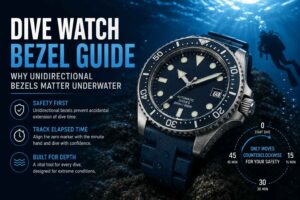
What Is a Dive Watch Bezel?
A dive watch bezel is the rotating ring surrounding the watch crystal.
Divers use it to measure elapsed dive time by aligning the zero marker with the minute hand before entering the water.
Unlike digital timers, a mechanical bezel requires no battery and remains highly reliable in harsh environments.
Today, rotating bezels have become one of the defining characteristics of modern dive watches, combining practical functionality with a bold, sporty appearance.
Why Are Dive Watch Bezels Unidirectional?
One of the most common questions is:
Why can a dive watch bezel only rotate counterclockwise?
The answer is simple: safety.
If the bezel accidentally moves underwater, a unidirectional bezel can only shorten the remaining dive time rather than extend it.
For example:
- Planned dive time: 40 minutes
- Bezel accidentally moves forward by 5 minutes
The diver now believes only 35 minutes remain instead of 40, encouraging an earlier and safer ascent.
If the bezel rotated in both directions, accidental movement could falsely increase the remaining dive time, creating unnecessary risk.
This simple mechanical design has become the industry standard for professional dive watches.
What Makes a High-Quality Dive Watch Bezel?
Not all bezels perform the same.
Experienced dive watch manufacturers pay close attention to several important details.
Precise Click Action
Most premium dive watches use:
- 60-click bezels
- 120-click bezels
A quality bezel should provide:
- Crisp feedback
- Even resistance
- Minimal back play
Smooth, consistent clicks immediately communicate a higher level of craftsmanship.
Strong Grip Design
Divers often operate the bezel while wearing gloves.
Deep knurling or coin-edge patterns provide better grip, making adjustments easier even in wet conditions.
Good ergonomics are just as important as attractive styling.
Durable Bezel Inserts
Common bezel insert materials include:
- Aluminum
- Ceramic
- Stainless steel
Ceramic inserts have become increasingly popular because they offer:
- Excellent scratch resistance
- UV resistance
- Long-lasting color stability
Many premium custom dive watch projects now specify ceramic bezels to improve perceived product quality.
Luminous Zero Marker
The luminous marker at the 12 o’clock position allows divers to read elapsed time in low-light underwater environments.
This small feature significantly improves usability and is considered a hallmark of a professional dive watch.
Why Bezel Quality Matters to Watch Brands
Consumers often judge a dive watch within seconds.
The first interaction usually involves rotating the bezel.
A bezel with excessive play, inconsistent clicks, or poor alignment immediately lowers the perceived quality of the entire watch.
For brands, investing in a better bezel mechanism often delivers a stronger customer impression than simply increasing specifications on paper.
How Dive Watch Manufacturers Test Bezel Quality
A professional dive watch factory doesn’t simply install the bezel—it tests it throughout production.
Typical inspections include:
- Click consistency
- Rotational resistance
- Alignment accuracy
- Insert bonding strength
- Durability testing
At Hongliyuan Watch, bezel components are carefully inspected alongside water resistance testing to ensure every finished watch meets both functional and aesthetic expectations.
Choosing the Right Bezel for Your Custom Dive Watch
When designing a custom dive watch, consider the following:
- 120-click unidirectional bezel
- Ceramic bezel insert
- Strong luminous pip
- Deep grip profile
- Precise alignment with dial markers
These features improve both functionality and the perceived value of the finished watch.
Combined with proper water resistance, they create a product that stands out in today’s competitive market.
Conclusion
A dive watch bezel is much more than a design element.
It is a critical safety feature that improves underwater timing while giving dive watches their iconic appearance.
For brands developing custom dive watches, focusing on bezel quality, click feel, material selection, and manufacturing precision can significantly improve the final product.
If you haven’t already, we also recommend reading our previous guide, “How Much Water Resistance Does a Dive Watch Really Need?“, to better understand how water resistance and bezel design work together in professional dive watch development.
With more than 30 years of experience in quartz and mechanical watch manufacturing, Hongliyuan Watch helps global brands develop reliable, high-quality dive watches from concept to mass production.
FAQ About Dive Watch Bezels
Why do dive watch bezels rotate in only one direction?
A unidirectional bezel prevents accidental extension of dive time, making underwater timing safer.
Is a 120-click bezel better than a 60-click bezel?
Generally, yes. A 120-click bezel offers finer adjustment and smoother operation, although overall manufacturing quality is more important than click count alone.
What is the best material for a dive watch bezel?
Ceramic is widely regarded as the premium choice because it offers superior scratch resistance, color stability, and durability.
How can I tell if a dive watch bezel is high quality?
Look for smooth click action, minimal back play, accurate alignment, durable materials, and solid construction.
Can a dive watch bezel be customized?
Yes. Professional dive watch manufacturers can customize bezel materials, colors, markings, click systems, and luminous markers according to your brand requirements.