
When choosing which watch bracelet is more comfortable, there is no single answer for every watch or wearer. For B2B watch brands, comfort depends on more than the bracelet material—it also depends on weight, flexibility, taper, clasp adjustment, wrist size, climate, and how the bracelet integrates with the case.
For most everyday watches, a well-designed 316L stainless steel bracelet offers the best balance of durability, appearance, adjustability, and perceived value. Titanium is lighter, while FKM rubber performs better for sports and hot environments. Leather remains attractive for dress and business watches.
The right choice should therefore match your watch’s positioning and target market rather than simply choosing the softest material.
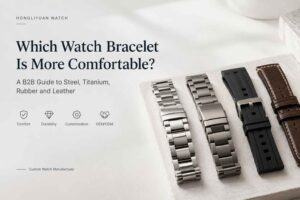
What Actually Makes a Watch Bracelet Comfortable?
A comfortable bracelet is not determined by material alone. The way the bracelet moves with the wrist can be just as important.
Weight and Wrist Balance
A heavy bracelet can make a watch feel substantial, but excessive weight may cause fatigue during long periods of wear.
Titanium has a significant advantage here because it is much lighter than stainless steel. This makes it particularly useful for larger sports watches, outdoor watches, and watches designed for all-day wear.
For a 40–42mm watch, bracelet weight should also be considered together with case weight. A lightweight bracelet paired with a heavy case may still feel unbalanced.
Flexibility and Link Design
Bracelet links need enough articulation to follow the natural curve of the wrist.
Solid stainless steel bracelets can be comfortable when the links are relatively small, the edges are properly finished, and the bracelet tapers toward the clasp.
For example, a 20mm bracelet that tapers toward 16–18mm at the clasp can feel less bulky than a straight 20mm bracelet.
Micro-Adjustment Matters
Even a premium bracelet can feel uncomfortable if the wearer cannot achieve the correct fit.
A clasp with 3–6 micro-adjustment positions can make a noticeable difference. Wrist circumference can also change during the day due to temperature, activity, and hydration.
For B2B buyers, clasp adjustment should therefore be treated as a comfort specification, not simply a hardware detail.
Which Material Is Most Comfortable?
The four most common choices for custom watches are stainless steel, titanium, rubber/FKM, and leather.
316L Stainless Steel: The Balanced Choice
316L stainless steel remains one of the most practical options for B2B watch production.
It provides good corrosion resistance, a solid feel, and compatibility with brushed, polished, bead-blasted, and PVD finishes.
A solid 316L bracelet typically costs more than a basic folded bracelet, but the difference can be justified when the product is positioned as a premium mechanical or sports watch. Public B2B component references commonly place solid stainless bracelets around the upper single-digit to low-double-digit USD range before more complex customization and finishing.
Titanium: Best for Lightweight Watches
Titanium is worth considering when reducing wrist weight is a priority.
It can be particularly suitable for 40–44mm field watches, sports watches, outdoor watches, and tool-watch concepts.
The trade-off is manufacturing cost. Titanium cases and bracelets generally require different machining and finishing considerations, so the total OEM cost can be higher than an equivalent stainless steel configuration.
FKM Rubber: Best for Sports and Hot Climates
FKM rubber is a strong choice for diving watches, sports watches, and customers who frequently encounter water, sweat, or high temperatures.
It is softer and more flexible than a conventional metal bracelet and does not require link adjustment.
However, the bracelet needs to be properly designed around the case and buckle. A thick rubber strap can actually feel less comfortable than a well-designed steel bracelet if the strap does not flex naturally.
Leather: Best for Dress and Business Watches
Leather provides a different type of comfort.
It gradually conforms to the wrist and can create a softer wearing experience, especially on slim watches.
The limitation is environmental exposure. Leather is less suitable for frequent swimming, diving, heavy sweating, or humid outdoor use.
For business watches and minimalist collections, however, leather remains a practical choice.
Comfort Comparison for B2B Watch Development
The table below provides a practical starting point when discussing bracelet specifications with an OEM watch supplier.
| Bracelet Type | Comfort Profile | Typical Use | Durability | Approx. Component Cost* | OEM Consideration |
|---|---|---|---|---|---|
| 316L Stainless Steel | ★★★★☆ | Everyday, sports, mechanical | High | ~$8–20+ | Link design and clasp are critical |
| Titanium | ★★★★★ | Field, outdoor, premium sports | High | Higher than steel | Lightweight but more expensive |
| FKM Rubber | ★★★★☆ | Diver, sports, hot climates | Very High | ~$2–5+ | Mold and color matching may add cost |
| Genuine Leather | ★★★★☆ | Dress, business, fashion | Medium | ~$3–8+ | Material quality and lining matter |
| Nylon / Fabric | ★★★★☆ | Field, casual, outdoor | Medium | ~$1–3+ | Easy to customize and replace |
*Indicative component-level ranges only. Actual OEM pricing depends on material grade, construction, finishing, clasp, tooling, order quantity, and supplier. Public B2B manufacturing references show similar ranges, but they should not be treated as universal quotations.
Don’t Compare Materials Alone
A $10 bracelet is not necessarily less comfortable than a $20 bracelet.
Construction matters.
A well-machined bracelet with rounded edges, smaller links, proper taper, and useful micro-adjustment can outperform a more expensive bracelet with poor proportions.
Bracelet Cost Can Affect the Final Watch
For entry-level quartz watches, bracelet cost can represent a surprisingly large portion of the total product cost.
For a B2B project, changing from a basic strap to a solid 316L bracelet can increase unit cost while also increasing perceived product value.
This is why bracelet selection should be made during the initial product development stage rather than after the case and dial have already been finalized.
How Should B2B Buyers Choose a Bracelet?
The best bracelet depends on the watch’s positioning, target customer, and expected environment.
For Diver and Sports Watches
For dive watches, consider 316L stainless steel or FKM rubber.
A stainless bracelet works well for a premium everyday diver, while FKM is often more practical for customers who prioritize flexibility and water exposure.
For example, Hongliyuan Watch currently offers custom diver configurations using 316L stainless steel bracelets, sapphire crystal, and 20ATM water resistance.
For Field and Outdoor Watches
Field watches benefit from lightweight and flexible solutions.
Titanium, nylon, canvas, and lightweight steel bracelets can all work depending on the intended price segment.
For a 39–40mm field watch, avoiding excessive bracelet weight can help preserve the compact, practical character of the product.
For Dress and Business Watches
Leather and slim stainless steel bracelets are usually easier to integrate into a business-oriented design.
A thinner case combined with a tapered bracelet can create a cleaner visual proportion.
For a custom logo watch, the clasp, buckle, or bracelet links can also become additional branding surfaces.
What Should You Specify to Your Watch Manufacturer?
A bracelet should be developed together with the case, not treated as an independent accessory.
Confirm the Technical Dimensions
Before requesting an OEM quotation, provide:
- Lug width: commonly 18mm, 20mm or 22mm
- Bracelet width and taper
- Bracelet thickness
- Wrist-size range
- Link construction
- Clasp type
- Micro-adjustment positions
- End-link design
- Surface finishing
- Logo requirements
- Required material grade
Case and bracelet integration is especially important for custom watches. Even bracelets with the same lug width may not fit correctly because end-link geometry, lug-hole position, and case curvature can differ.
Consider Tooling and Production Time
Custom rubber straps and metal bracelets may require tooling or additional development.
For example, custom bracelet tooling can be several hundred dollars depending on construction, while custom rubber/FKM colors may require color samples or mold development. Public OEM strap references show bracelet tooling around several hundred USD per style, although actual factory quotations vary by structure and order volume.
A standard custom watch project may take around 25–35 days after design approval, while more complex mechanical watches can require 45–60 days.
For a new bracelet design, allow additional time for prototype adjustment before mass production.
Test the Complete Watch
Do not evaluate bracelet comfort separately from the watch head.
The final sample should be tested for:
- Wrist balance
- Link flexibility
- Clasp pressure
- Sharp edges
- Hair pulling
- Wrist movement
- Bracelet noise
- Clasp security
- Water and sweat exposure where applicable
This is particularly important for a new oem odm watch, because changing the bracelet late in development can affect case geometry, tooling, cost, and delivery schedules.
FAQ: Which Watch Bracelet Is More Comfortable?
1. Is titanium more comfortable than stainless steel?
Titanium is generally lighter, so it can feel more comfortable for larger watches or long periods of wear. However, comfort also depends on bracelet construction, clasp design, and overall watch balance.
2. Is FKM rubber better than stainless steel for a dive watch?
It depends on the product positioning. FKM rubber provides flexibility and works well around water and sweat, while stainless steel offers a more substantial appearance and can better support a premium everyday-diver positioning.
3. How much does a custom stainless steel bracelet cost?
As an indicative OEM component range, a basic-to-moderately complex stainless steel bracelet may fall around $8–20+ per unit, before unusual finishing, advanced clasps, tooling, packaging, and other development costs. Actual quotations depend heavily on volume and construction.
4. Does bracelet material affect MOQ?
It can. Standard bracelets may have relatively straightforward production requirements, while a completely new bracelet design may require tooling and development. The final MOQ depends on the factory, bracelet construction, tooling investment, and order quantity.
5. Can a watch manufacturer customize the bracelet and clasp?
Yes. An experienced custom watch manufacturer can usually customize bracelet dimensions, links, finishes, clasps, engraving, and logo placement. The bracelet should ideally be developed together with the case to ensure proper fit.
Conclusion: Choose Comfort Based on the Watch, Not Just the Material
So, which watch bracelet is more comfortable? There is no universal winner.
For a balanced everyday product, 316L stainless steel is a strong choice. For lightweight premium watches, consider titanium. For diving and sports applications, FKM rubber is highly practical, while leather remains well suited to dress and business watches.
For B2B brands, the most important point is to evaluate the complete system: material + weight + link construction + taper + clasp + micro-adjustment + case integration + target market.
Hongliyuan Watch provides OEM/ODM customization for quartz and mechanical watches, including stainless steel, titanium, FKM and other strap configurations. The factory’s current capabilities cover design, case manufacturing, assembly, testing and customization, allowing bracelet specifications to be considered as part of the complete watch development process.
If you are developing a new collection, you can also explore our guides on [How to Plan Your OEM Watch Budget], [Why Visit Your OEM Watch Factory Before Ordering], [Custom Minimalist Quartz Watches], and [Why Do Dive Watches Need a Screw-Down Crown] before finalizing your specifications. These topics can help you evaluate cost, supplier capability, product positioning, and technical requirements.
For a custom project, contact Hongliyuan Watch to discuss your case, bracelet, movement, dial, logo, and production requirements with an experienced OEM watch supplier.