
Introduction
You don’t need a large investment to start a watch brand. Many successful microbrands began with a single well-designed watch, a realistic budget, and an experienced OEM manufacturing partner. What matters most is making smart decisions about product development, manufacturing, and cost control—not spending the most money.
If you’re planning to start a watch brand, this guide explains how to launch efficiently, avoid common mistakes, and work with the right custom watch manufacturer to build a product customers will trust.
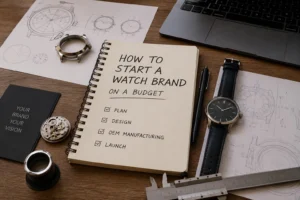
Can You Start a Watch Brand With a Limited Budget?
Answer: Yes. Thanks to modern OEM watch manufacturing, entrepreneurs can launch a professional watch brand without owning a factory or investing heavily in production equipment.
Today’s manufacturers provide complete development services, including engineering, prototyping, sourcing, assembly, and quality inspection. This allows startups to focus on branding, product positioning, and customer acquisition instead of building manufacturing capabilities from scratch.
Start With One Hero Product
Launching multiple models at the same time often increases inventory costs and slows decision-making.
Instead, focus on one carefully planned watch that clearly represents your brand.
A single successful model helps you:
- Validate market demand
- Collect customer feedback
- Build brand recognition
- Improve cash flow
Many well-known microbrands expanded their collections only after their first model proved successful.
Choose an OEM Partner Instead of Building Your Own Supply Chain
Working with an experienced watch factory provides immediate access to:
- Reliable component suppliers
- Engineering support
- Quality management
- Established production processes
This approach dramatically reduces development risks for first-time founders.
Keep Your First Collection Simple
Your first product doesn’t need every premium feature available.
Instead, prioritize features customers truly value:
- Reliable Japanese or Swiss movement
- 316L stainless steel case
- Sapphire crystal
- Comfortable strap
- Clean, timeless design
Keeping the design practical also reduces tooling costs and shortens development time.
Key Takeaway
The smartest way to start a watch brand is by focusing on one excellent product instead of trying to launch an entire collection.
Where Should You Invest Your Budget?
Answer: Spend money on the product itself before investing heavily in packaging or marketing. Customers buy watches because of quality, reliability, and design—not because of expensive presentation boxes.
Invest in Reliable Components
The movement is the heart of every watch.
Reliable options from manufacturers such as Miyota, Seiko Epson, and Ronda provide excellent long-term performance while keeping production costs under control.
Likewise, choosing 316L stainless steel and sapphire crystal improves durability and increases the perceived value of your watch.
Save Money on Non-Essential Customization
Completely custom cases, bracelets, and molds are expensive.
For a first project, consider using proven case platforms while customizing:
- Dial design
- Hands
- Logo
- Case back engraving
- Packaging
This strategy creates a distinctive product without significantly increasing development costs.
Allocate Budget for Prototypes
Never skip prototype development to save money.
A prototype helps verify:
- Product proportions
- Surface finishing
- Dial printing
- Hand alignment
- Wearing comfort
- Water resistance
Correcting issues before mass production is always less expensive than fixing finished inventory.
Key Takeaway
Smart investments focus on product quality first. Premium packaging and advanced customization can always be introduced in later collections.
Budget Allocation Guide for New Watch Brands
Answer: A balanced budget helps startups maximize product quality while protecting cash flow during launch.
| Investment Area | Priority | Recommendation |
|---|---|---|
| Movement | ★★★★★ | Choose proven Japanese or Swiss movements |
| Case & Crystal | ★★★★★ | Invest in 316L stainless steel and sapphire crystal |
| Dial & Hands | ★★★★☆ | Strong visual identity creates brand recognition |
| Prototype Development | ★★★★★ | Never skip sample evaluation |
| Packaging | ★★★☆☆ | Keep packaging clean and practical |
| Product Photography | ★★★★☆ | Essential for e-commerce and crowdfunding |
| Website | ★★★★☆ | Build a professional brand presence |
| Marketing | ★★★★☆ | Scale spending after validating your first product |
For most startup brands, product quality should receive a higher budget priority than luxury packaging or large advertising campaigns.
How Can You Reduce Manufacturing Costs Without Sacrificing Quality?
Answer: Reducing costs doesn’t mean choosing the cheapest components. Instead, it means making smart design and sourcing decisions that improve manufacturing efficiency while maintaining product quality.
Many first-time entrepreneurs assume lowering the price requires compromising quality. In reality, experienced OEM manufacturers know that thoughtful engineering often delivers greater savings than cheaper materials.
Standardize Components Whenever Possible
Using standard components can significantly reduce both tooling costs and production lead times.
For example, choosing common case sizes such as 38 mm, 40 mm, or 42 mm, along with standard strap widths like 20 mm or 22 mm, allows manufacturers to use existing production resources more efficiently.
Select Reliable Off-the-Shelf Movements
Developing a proprietary movement is unrealistic for most startups.
Instead, proven calibers from Miyota, Seiko Epson, or Ronda offer dependable performance, easier servicing, and lower development costs.
These movements are widely recognized by consumers and provide an excellent balance between quality and affordability.
Plan for Future Product Expansion
Think beyond your first release.
Designing your first watch around reusable components—such as the same case, bracelet, or crystal—makes it easier to introduce new dial colors or limited editions without investing in entirely new tooling.
Key Takeaway
Cost control is achieved through better engineering decisions, not by reducing product quality.
Why Choosing the Right Watch Manufacturer Is Critical
Answer: Your manufacturing partner influences every aspect of your business, from product quality and production efficiency to customer satisfaction and long-term brand growth.
The lowest quotation isn’t always the best value. A reliable manufacturer helps prevent costly mistakes long before production begins.
Look Beyond Unit Price
When comparing suppliers, consider factors such as:
- Engineering support
- Prototype capability
- Quality management
- Communication speed
- Production consistency
- After-sales support
A slightly higher unit price can often save thousands of dollars by reducing revisions and quality issues.
Choose a Factory That Supports New Brands
Launching a watch brand startup requires more than manufacturing.
An experienced custom watch manufacturer should also help you:
- Evaluate product feasibility
- Recommend suitable materials
- Optimize production costs
- Improve manufacturability
- Plan realistic production schedules
This guidance is especially valuable for entrepreneurs with limited industry experience.
Build a Long-Term Manufacturing Partnership
The most successful brands rarely change factories every year.
Working with one trusted partner creates consistency in quality, simplifies future product development, and improves production efficiency as your business grows.
At Hongliyuan Watch, we’ve worked with startups, established brands, and corporate clients for over 30 years. Our OEM and ODM experience allows us to help customers avoid common development mistakes while delivering reliable production solutions.
Key Takeaway
Choose a manufacturing partner that supports your long-term business—not just your first production order.
Frequently Asked Questions
How much money do I need to start a watch brand?
The investment depends on your product specifications, order quantity, and marketing strategy. Many startups begin with one carefully planned model and gradually expand after validating market demand.
What is the ideal MOQ for a new watch brand?
For many OEM projects, a starting quantity of 100–300 pieces is common. The exact MOQ depends on the movement, case construction, and level of customization.
Should I choose quartz or automatic watches first?
Quartz watches usually require a lower investment and are suitable for fashion, promotional, and entry-level brands. Automatic watches often appeal to enthusiasts and premium microbrands but involve higher production costs.
Can I fully customize my watch?
Yes. However, complete customization increases tooling costs and development time. Many successful startups customize the dial, hands, logo, and case back while using proven case designs for the first production run.
How long does OEM watch production usually take?
A typical project takes 45–90 days, including engineering review, prototype development, sample approval, mass production, and quality inspection.
Conclusion
Starting a watch brand isn’t about having the biggest budget—it’s about making the right decisions from the very beginning.
The most successful microbrands don’t launch with dozens of models or unlimited resources. They start with a clear product vision, carefully selected components, and an experienced manufacturing partner who understands how to turn ideas into market-ready products.
At Hongliyuan Watch, we’ve spent more than 30 years helping entrepreneurs, established brands, and global businesses develop high-quality custom watches through professional OEM Watch Manufacturing and ODM Watch Manufacturing services. From design evaluation and prototype development to quality control and mass production, our team works alongside you at every stage to reduce risk, control costs, and bring your watch to market with confidence.
If you’re ready to start a watch brand, we’d be happy to review your concept, discuss manufacturing options, and recommend the most cost-effective solution based on your goals and budget.
Contact Hongliyuan Watch today to request a free project consultation or prototype evaluation—and take the first step toward building a watch brand that stands out in today’s competitive market.