
Introduction
Visiting an OEM Watch Factory before placing a large order is one of the most effective ways to reduce manufacturing risk. A website, product catalog, and video call can show capabilities, but they cannot fully reveal how a factory manages production, quality control, communication, and problem-solving.
For watch brands, especially startups developing a custom collection for the first time, a factory visit can help verify whether the supplier is genuinely capable of producing the watch you have designed.
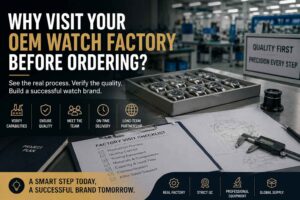
Why Does Visiting an OEM Watch Factory Matter?
Answer: A factory visit allows buyers to verify real production capabilities instead of relying only on sales presentations.
See the Actual Production Process
An OEM Watch Factory may outsource some processes while handling others in-house. Neither model is automatically good or bad, but buyers should understand exactly who is responsible for each production stage.
During a visit, ask to see how the factory handles:
- Component sourcing
- Case and dial preparation
- Assembly
- Water-resistance testing
- Quality inspection
- Packaging
- Final shipment
This provides a clearer picture of the real supply chain behind your order.
Verify Equipment and Working Conditions
Production equipment does not guarantee quality, but it can reveal the factory’s level of technical investment.
Look for organized assembly areas, testing equipment, clear work procedures, and appropriate storage for components and finished products.
A reliable watch manufacturer should also be able to explain how production standards are maintained from one batch to the next.
Meet the Team Behind Your Project
A factory visit is also about communication.
Meeting project managers, engineers, quality-control staff, and production supervisors helps you understand who will handle your project after the order is confirmed.
Key Takeaway: A factory visit helps buyers verify capabilities, processes, and people—not just products.
What Should You Inspect During a Factory Visit?
Answer: Focus on the processes that directly affect your watch’s quality, delivery time, and consistency.
Quality Control and Testing
Ask how incoming components are inspected before assembly.
For example, a factory may check:
- Case dimensions
- Dial color consistency
- Hand alignment
- Movement function
- Strap fit
- Cosmetic defects
For water-resistant watches, ask how testing is performed and whether testing standards match your product specification.
Assembly Quality
Observe the working environment and assembly process.
Small details matter, including dust control, handling procedures, workstation organization, and whether components are protected from scratches during production.
A custom watch manufacturer should be able to explain how it controls defects before watches reach final inspection.
Prototype and Sample Development
Ask about the sample process.
For a typical custom project, prototype development can take roughly 7–20 working days, depending on component availability and design complexity. Projects requiring new molds, custom cases, or unique components can take longer.
Key Takeaway: Inspect the quality system and development process, not just the finished watches displayed in a showroom.
Factory Visit vs Remote Supplier Evaluation
A remote evaluation can be useful during early supplier research, but an in-person visit provides additional information that is difficult to confirm online.
| Evaluation Area | Remote Evaluation | Factory Visit |
|---|---|---|
| Product Samples | Can be shipped | Can be inspected directly |
| Production Equipment | Photos or video | Verified in person |
| Quality Control | Explained by supplier | Process can be observed |
| Production Capacity | Reported by supplier | Workflow can be evaluated |
| Communication Team | Video calls | Face-to-face meetings |
| Supply Chain Understanding | Limited | More transparent |
| Custom Development | Discussed remotely | Engineers can review details directly |
| Risk Assessment | Moderate | Higher confidence |
For smaller projects, an on-site visit may not always be practical. In that case, a detailed video audit, third-party inspection, and pre-production sample review can help reduce risk.
How Can a Factory Visit Help Control Costs?
Answer: Seeing the production process can help buyers identify unnecessary complexity before it becomes an expensive problem.
Review the Design With Engineers
A design that looks simple in a rendering may be difficult or expensive to manufacture.
During a factory visit, you can discuss details such as:
- Case construction
- Applied indices
- Custom logos
- Strap integration
- Movement compatibility
- Packaging
This is particularly valuable for a custom logo watch, where logo placement, dial finishing, and component tolerances can affect both appearance and cost.
Understand MOQ and Production Planning
MOQ requirements can vary depending on the movement, case design, dial construction, and customization level.
Ask the factory how production volume affects unit pricing. In many OEM projects, higher quantities can reduce per-unit costs because tooling and development expenses are distributed across more watches.
Confirm the Production Timeline
A typical watch production schedule may include:
- Design and specification confirmation
- Sample development
- Sample approval
- Component preparation
- Mass assembly
- QC and final inspection
For relatively standard designs, mass production may take approximately 30–60 days after sample approval and material confirmation. Complex custom projects may require additional time.
Key Takeaway: A factory visit can identify cost and timeline issues before they affect mass production.
What Questions Should You Ask Your OEM Watch Factory?
Answer: The best questions focus on capability, quality, responsibility, and communication.
Ask What Is Made In-House
Do not assume that every component is produced by the factory you visit.
Ask which processes are managed internally and which are handled by specialized suppliers. Transparency is more important than claiming that everything is produced in one location.
Ask How Problems Are Handled
Every manufacturing project can encounter issues.
Ask your OEM watch supplier:
- Who approves production changes?
- How are defects documented?
- What happens if components fail inspection?
- How are delivery delays communicated?
A supplier’s problem-solving process can be as important as its initial quotation.
Ask Who Will Manage Your Project
Clarify your main point of contact.
For custom projects, efficient communication between the buyer, project manager, engineering team, and production department can prevent misunderstandings during sampling and mass production.
Key Takeaway: A professional factory should be able to answer difficult questions clearly and consistently.
Common Mistakes Buyers Make When Visiting a Factory
Focusing Only on the Showroom
A polished showroom does not necessarily represent the factory’s production capabilities.
Spend more time reviewing assembly, inspection, testing, and project management processes.
Not Preparing Questions in Advance
A factory visit can move quickly.
Prepare your product specifications and questions before arriving. Bring drawings, reference samples, color requirements, and technical concerns where possible.
Approving Production Too Quickly
A factory visit should support better decision-making, not replace the sample approval process.
Always review the actual prototype and confirm specifications before approving mass production.
FAQ
1. Is it necessary to visit an OEM Watch Factory before placing an order?
It is not always necessary, especially for smaller projects or international buyers. However, visiting a factory can provide valuable insight into production capabilities, quality control, and communication processes before committing to a larger order.
2. What should I look for when visiting a watch manufacturer?
Focus on production workflow, assembly conditions, quality-control procedures, testing equipment, sample development, project management, and component handling. The goal is to understand how the factory operates, not simply how the showroom looks.
3. Can I visit an OEM Watch Factory before requesting samples?
Yes. Visiting early can help you discuss your design direction with the factory before sampling begins. However, many buyers first request a quotation and technical discussion, then arrange a visit when the project becomes more defined.
4. How long does custom watch production usually take?
Timing varies by design complexity and component availability. Sample development may take around 7–20 working days for standard custom projects, while mass production often takes around 30–60 days after final sample approval.
5. What if I cannot visit the factory in person?
Ask for a live video factory tour, detailed production documentation, sample shipments, and third-party quality inspections. A combination of these methods can help buyers evaluate an OEM Watch Factory remotely.
6. Can a factory visit help reduce production costs?
Yes. Direct discussions with engineers and production teams can identify unnecessary design complexity, alternative materials, or more efficient production methods before mass production begins.
7. Should I bring my watch design files to the factory visit?
Yes. Bring technical drawings, reference images, dimensions, material requirements, logo files, and target specifications. The more clearly you communicate your requirements, the easier it is for the factory to evaluate feasibility.
Conclusion
Choosing an OEM partner is a major decision for any watch brand. A factory website can introduce a supplier, but a factory visit can reveal how that supplier actually manages production, quality, communication, and technical problems.
If your project involves a new custom case, dial, movement configuration, or significant production investment, visiting the factory can provide valuable information before you move forward.
At Hongliyuan Watch, we believe buyers should understand the manufacturing process behind their products. A professional OEM relationship should be based on transparent communication, realistic production planning, sample verification, and clear quality standards.
If you are planning a custom watch project, you may also find these guides helpful:
- OEM Watch Factory: What Should You Ask First?
- Best Ways to Communicate With Your Watch Manufacturer
- How to Prepare Files for Custom Watch Design
- Custom Watch Design: 10 Costly Mistakes to Avoid Before Production
- How to Start a Watch Brand on a Budget
Whether you visit in person or evaluate suppliers remotely, the goal is the same: choose a manufacturing partner that can understand your product and manage the project reliably from prototype to final delivery.
Planning your next watch collection? Contact Hongliyuan Watch to discuss your specifications, factory capabilities, sampling requirements, and OEM production plan before placing your order.
Key Takeaways
- Visiting an OEM Watch Factory helps verify real production capabilities.
- Focus on quality control, assembly, testing, and project management—not only the showroom.
- Factory visits can identify potential cost and production issues early.
- Bring technical files and prepared questions to make the visit more productive.
- If an in-person visit is not possible, combine video audits, samples, and third-party inspections.