
Introduction
FKM vs Silicone Watch Strap is a common question for watch brands choosing materials for a new collection. In general, FKM rubber tends to last longer in demanding conditions, especially when exposed to heat, oils, chemicals, and frequent outdoor use. Silicone, however, remains an excellent choice when softness, flexibility, comfort, and cost are the priority.
For brands developing custom watches, the better material depends on the product’s positioning, target market, expected usage, and production budget—not simply which strap is more expensive.
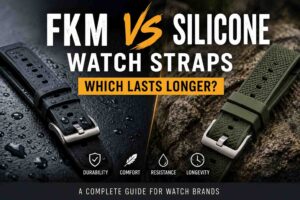
FKM vs Silicone: What Is the Difference?
Answer: FKM and silicone are both flexible materials used for watch straps, but their chemical composition and performance characteristics are different.
What Is an FKM Watch Strap?
FKM is a type of high-performance fluoroelastomer known for its resistance to heat, oils, chemicals, and environmental exposure.
It is often selected for sports watches, dive watches, tool watches, and premium outdoor-oriented products where durability is important.
FKM straps also tend to have a denser, more substantial feel than standard silicone.
What Is a Silicone Watch Strap?
Silicone is a soft, flexible material widely used in sports, casual, fashion, and everyday watches.
Its main advantages are comfort, flexibility, and the ability to produce a wide range of colors and surface finishes. Silicone is also generally easier to use when cost efficiency is an important consideration.
Which Material Feels Better?
This depends on the wearer.
Silicone usually feels softer and more flexible immediately. FKM can feel firmer and more structured, but many users prefer its more premium tactile quality.
Key Takeaway: Silicone prioritizes softness and flexibility, while FKM is generally better suited to demanding environments and long-term durability.
Which Watch Strap Lasts Longer?
Answer: FKM generally has the advantage when a watch strap is exposed to harsh environmental conditions or frequent use.
Resistance to Heat and Chemicals
One of FKM’s biggest advantages is its resistance to heat, oils, fuels, and many chemicals.
This makes it particularly useful for outdoor, industrial, motorsport, and professional-style watches.
Silicone performs well in normal temperature and everyday conditions, but it is not designed to provide the same level of chemical resistance.
Resistance to Sweat and Daily Wear
Both materials can work well for active watches because they are flexible and resistant to moisture.
However, long-term performance also depends on strap thickness, formulation, molding quality, buckle construction, and how frequently the watch is worn.
A poorly manufactured FKM strap will not automatically outperform a well-made silicone strap.
UV and Environmental Exposure
FKM is generally better suited to prolonged exposure to demanding environmental conditions.
Silicone can also provide good outdoor performance, but its aging characteristics depend heavily on material quality and formulation.
Key Takeaway: If long-term resistance is the primary goal, FKM is usually the stronger choice. For normal daily wear, high-quality silicone can still provide excellent service life.
FKM vs Silicone Watch Strap: Cost and Performance
Answer: The material should be selected according to the watch’s target retail price and intended use.
For a custom watch manufacturer, choosing a strap is not simply a material decision. It affects the product’s perceived value, production cost, comfort, and brand positioning.
Material and Performance Comparison
| Feature | FKM Strap | Silicone Strap |
|---|---|---|
| Durability | Excellent | Good |
| Heat Resistance | Excellent | Good |
| Chemical Resistance | Excellent | Moderate |
| Flexibility | Very Good | Excellent |
| Softness | Firm to Medium | Very Soft |
| Sweat Resistance | Excellent | Excellent |
| Outdoor Use | Excellent | Good |
| Premium Feel | High | Medium |
| Color Options | Good | Excellent |
| Relative Cost | Higher | Lower |
The exact cost varies according to strap dimensions, surface treatment, buckle type, logo customization, packaging, MOQ, and production volume.
When Should a Brand Choose FKM?
FKM is a strong option for:
- Dive watches
- Field watches
- Sports watches
- Tool watches
- Premium microbrand collections
- Outdoor-focused products
It can reinforce a technical and professional product image.
When Is Silicone the Better Choice?
Silicone is often more practical for:
- Fashion watches
- Casual watches
- Entry-level sports watches
- Promotional watches
- Color-focused collections
- Cost-sensitive projects
For brands ordering their first collection, silicone may provide a better balance between comfort, appearance, and manufacturing cost.
Key Takeaway: FKM offers stronger performance characteristics, while silicone can deliver excellent comfort and cost efficiency.
How Should You Choose a Strap for Custom Watch Production?
Answer: Start with the watch’s intended customer and usage scenario, then work backward to the appropriate material. For brands developing a custom watch strap, these details should be confirmed during the prototype stage rather than after mass production begins.
Match the Strap to the Watch Design
A technical dive watch usually benefits from a robust rubber strap, while a fashion-oriented watch may need a softer and more colorful material.
The strap should also complement:
- Case diameter
- Lug width
- Case finishing
- Dial design
- Buckle style
- Overall retail positioning
A mismatch can make an otherwise well-designed watch feel unfinished.
Consider the Target Price
For a new watch brand, every component affects the final margin.
If the target retail price is highly competitive, a well-designed silicone strap may provide enough performance without adding unnecessary material costs.
For a premium collection, upgrading to FKM can strengthen the product specification and customer perception.
Test Before Mass Production
Never evaluate a strap only from photographs.
During prototype development, check:
- Flexibility
- Surface texture
- Buckle fit
- Lug connection
- Wrist comfort
- Color accuracy
- Strap thickness
An experienced watch manufacturer can also identify potential molding or assembly problems before mass production.
Key Takeaway: Choose the strap based on product positioning, customer expectations, and real-world usage—not simply material reputation.
Common Mistakes When Choosing FKM or Silicone Straps
Answer: The biggest mistake is choosing a material based only on price or marketing claims.
Choosing FKM Without a Clear Reason
FKM is a high-performance material, but not every watch needs it.
Using FKM on a basic fashion watch may increase production costs without providing meaningful benefits to the target customer.
Choosing Silicone Only to Reduce Cost
The cheapest strap is not always the best option.
Poor material formulation, weak molding, inaccurate dimensions, or low-quality hardware can cause premature wear regardless of whether the strap is silicone or FKM.
Ignoring Strap-to-Case Integration
The strap should be considered during the watch design stage.
Lug geometry, spring bars, strap thickness, buckle dimensions, and case finishing all influence the final result.
Key Takeaway: Material quality matters, but manufacturing quality and product integration matter just as much.
FAQs
1. Does FKM last longer than silicone?
In demanding environments, FKM generally lasts longer because of its stronger resistance to heat, oils, chemicals, and environmental exposure. However, actual service life depends on material formulation, strap construction, molding quality, and usage. A high-quality silicone strap can still last for years under normal everyday conditions.
2. Is FKM better than silicone for dive watches?
FKM is often a strong choice for dive watches because it combines flexibility with excellent environmental resistance. Silicone can also work well for diving applications, especially when comfort and cost are priorities. The final choice should consider the watch’s intended market and overall specifications.
3. Is FKM more expensive than silicone?
Generally, yes. FKM is a higher-performance elastomer and typically costs more than standard silicone. However, the final strap price also depends on dimensions, customization, buckle hardware, surface finishing, MOQ, and production volume.
4. Can FKM and silicone straps be customized?
Yes. Both materials can be customized in colors, dimensions, surface textures, buckle configurations, and branding details. For OEM watch projects, customization should be finalized during the prototype stage so the strap can be tested together with the case.
5. Which strap is better for a premium watch?
FKM is often a better fit for premium sports, dive, and tool watches because its performance characteristics support a higher-end technical specification. However, premium positioning does not automatically require FKM. The material should match the design concept and target customer.
Conclusion: Choose the Material That Fits Your Watch
There is no universal winner in the FKM vs Silicone Watch Strap comparison.
FKM is generally the better choice for durability, chemical resistance, and demanding outdoor applications. Silicone is often the better choice when softness, flexibility, color variety, and cost efficiency matter more.
For brands developing a custom watch, the decision should be made together with the case, movement, dial, water-resistance requirements, target retail price, and customer profile.
If you are planning a new watch collection and are unsure which strap material fits your product, Hongliyuan Watch can help evaluate the specification during the OEM development process. From strap selection and prototype development to final production and quality inspection, the goal is to create a product that makes sense both technically and commercially.
For further reading, consider connecting this article with your existing guides on Dive Watch Bezel Guide: Why Unidirectional Bezels Matter Underwater, How Much Water Resistance Does a Dive Watch Really Need?, and Custom Watch Design: 10 Costly Mistakes to Avoid Before Production.
Planning your next custom watch project? Contact Hongliyuan Watch to discuss the right strap material, specifications, MOQ, and production solution for your collection.