
Introduction
Preparing the right files is one of the most overlooked steps in custom watch design, yet it has a direct impact on development speed, production costs, and final product quality. Many first-time watch brands spend weeks refining concepts, only to discover that their files are incomplete or unsuitable for manufacturing.
Whether you’re launching a microbrand, developing a corporate gift watch, or expanding an existing collection, providing organized design files allows your OEM watch factory to move efficiently from concept to prototype. This guide explains exactly what manufacturers need, why each file matters, and how proper preparation can save both time and money throughout the production process.
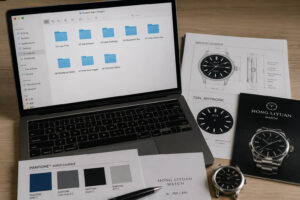
Why Are Design Files So Important for Custom Watch Design?
Answer: Well-prepared design files reduce misunderstandings, minimize prototype revisions, and accelerate communication between the customer and the manufacturer. They also improve engineering accuracy and help control production costs.
Many buyers believe a watch can be developed from a simple sketch. While rough concepts are helpful, production requires much more detailed information. Every missing specification increases the likelihood of additional revisions.
Professional OEM projects begin with organized documentation rather than assumptions.
Design Files Reduce Development Time
Every engineering decision depends on accurate information.
Providing complete files enables the factory to begin:
- CAD engineering
- Material evaluation
- Component sourcing
- Prototype planning
Without these files, engineers spend valuable time requesting missing information instead of developing your product.
Better Files Mean Fewer Prototype Revisions
Prototype revisions are normal.
However, incomplete documentation often creates unnecessary revisions involving:
- Dial artwork
- Logo positioning
- Hand length
- Case dimensions
- Crown placement
Clear design files help eliminate avoidable changes before sampling begins.
Organized Files Improve Communication
Most custom watch projects involve multiple teams.
Typical participants include:
- Brand owners
- Product designers
- Purchasing managers
- Engineers
- OEM watch manufacturers
Well-structured files ensure everyone works from the same specifications.
Key Takeaway
Investing time in preparing complete design files significantly shortens product development and reduces costly revisions.
What Files Does an OEM Watch Factory Actually Need?
Answer: Every project is different, but most professional manufacturers require artwork files, technical specifications, material preferences, branding assets, and reference images before engineering begins.
Think of these files as the blueprint for your entire project.
Logo Files
Your logo should always be supplied as vector artwork.
Preferred formats include:
- AI
- EPS
- SVG
- Editable PDF
Avoid low-resolution JPEG or PNG files whenever possible, as they cannot be accurately engraved, printed, or laser marked.
Watch Design Drawings
The more information you provide, the smoother the development process.
Helpful drawings include:
- Overall watch appearance
- Front and side views
- Dial layout
- Case back design
- Crown position
- Strap attachment
Professional CAD drawings are ideal, but even hand sketches with clear dimensions can be valuable during early discussions.
Color References
Color consistency is essential for brand identity.
Whenever possible, specify:
- Pantone colors
- Surface finish
- Texture
- Plating color
- Printing color
Terms such as “dark blue” or “silver gray” are often interpreted differently by suppliers.
Using internationally recognized color standards prevents unnecessary revisions.
Reference Images
Reference products help engineers understand your expectations.
Useful references may include:
- Case shape
- Bezel style
- Dial texture
- Hand design
- Bracelet structure
- Crown profile
Reference images communicate design intent much faster than written descriptions.
Key Takeaway
The more complete your design package, the more accurately an OEM watch factory can translate your vision into a manufacturable product.
Technical Specifications Every Manufacturer Needs
Answer: Beyond artwork, manufacturers require technical specifications that define how the watch will function, perform, and be assembled.
Without these details, engineers must make assumptions that may not match your expectations.
Movement Selection
One of the earliest decisions is movement choice.
Common options include:
- Miyota Quartz
- Seiko Epson Quartz
- Miyota Automatic
- Sellita Automatic
- Swiss Movements
Movement selection influences:
- Case thickness
- Dial feet
- Stem position
- Hand dimensions
- Production cost
Finalizing the movement early prevents costly engineering changes later.
Case Specifications
Manufacturers typically require:
- Case diameter
- Case thickness
- Lug width
- Material
- Surface finish
- Water resistance target
These specifications determine machining methods and tooling requirements.
Crystal, Strap and Packaging Requirements
Don’t overlook secondary components.
Provide specifications for:
- Sapphire or mineral crystal
- Strap material
- Buckle style
- Packaging
- User manual
- Warranty card
Planning these elements early keeps branding consistent throughout the entire product.
Key Takeaway
Technical specifications are just as important as visual design because they define how the watch will actually be manufactured.
Comparison Table — Essential Files for Custom Watch Design
| File Type | Recommended Format | Why It Matters |
|---|---|---|
| Logo Artwork | AI / EPS / SVG | Accurate engraving and printing |
| Dial Design | AI / PDF | Ensures precise dial production |
| Watch Drawings | PDF / CAD | Supports engineering evaluation |
| Color Reference | Pantone | Maintains color consistency |
| Material Specification | Excel / PDF | Confirms production materials |
| Movement Selection | Model Number | Determines engineering dimensions |
| Packaging Artwork | AI / PDF | Supports brand consistency |
| Reference Images | JPG / PNG | Communicates design intent quickly |
Proper documentation allows the OEM watch factory to evaluate your project efficiently, reduce communication errors, and begin prototype development with greater confidence.
How Should You Organize Your Files Before Sending Them?
Answer: A well-organized file package saves time for both your team and the manufacturer. Clear folder structures and consistent file names reduce communication errors and help engineers begin work immediately.
Many OEM projects are delayed not because of design complexity, but because files are scattered across emails, cloud drives, and messaging apps.
Create a Structured Project Folder
Instead of sending individual files one by one, organize everything into clearly labeled folders.
A recommended structure is:
Custom Watch Project
│
├── 01 Logo Files
├── 02 Dial Artwork
├── 03 Case Drawings
├── 04 Movement Information
├── 05 Color References
├── 06 Packaging Design
├── 07 Reference Images
└── 08 Technical Specifications
This simple structure makes it much easier for your OEM watch manufacturer to review the project and identify missing information before development begins.
Use Consistent File Names
Avoid vague file names such as:
- Final.pdf
- New Logo.ai
- Version 3.pdf
Instead, use descriptive names like:
- Brand_Dial_Artwork_V1.ai
- Case_40mm_Drawing.pdf
- Packaging_Design_V2.ai
- Pantone_Color_Reference.pdf
Consistent naming prevents version confusion during prototype revisions.
Include a Project Brief
A short project summary is extremely helpful.
Include information such as:
- Target retail price
- Target market
- Preferred movement
- Estimated order quantity
- Expected launch date
- Required certifications
- Special quality requirements
This allows engineers to recommend practical manufacturing solutions instead of making assumptions.
Key Takeaway
A clear folder structure, descriptive file names, and a concise project brief significantly improve communication and reduce unnecessary revisions.
Expert Advice from Hongliyuan Watch
Answer: Successful OEM projects begin long before production starts. Most manufacturing issues can be prevented through careful planning and early communication.
After more than 30 years of manufacturing quartz and mechanical watches, Hongliyuan Watch has found that the most successful customers are not necessarily those with the most detailed drawings—they are the ones who involve the factory early and remain open to engineering feedback.
Don’t Wait Until the Design Is “Perfect”
Many new brands hesitate to contact a factory because they believe every detail must be finalized first.
In reality, experienced manufacturers can improve your design before tooling begins.
Suggestions may include:
- Simplifying case construction
- Optimizing water resistance
- Improving assembly efficiency
- Selecting more suitable materials
- Reducing unnecessary tooling costs
Early collaboration often saves both time and money.
Think Beyond the First Prototype
The first sample is a validation tool, not the finished product.
At Hongliyuan Watch, prototype reviews typically focus on:
- Surface finishing
- Dial printing accuracy
- Hand alignment
- Crown operation
- Bezel feel
- Strap comfort
- Overall visual balance
Small refinements at this stage can make a significant difference in the final production quality.
Build a Long-Term Manufacturing Partnership
Choosing a factory should not be based solely on the first quotation.
A reliable OEM partner provides long-term value through:
- Engineering support
- Stable quality control
- Supply chain management
- Consistent communication
- Future product development
Many successful watch brands continue working with the same manufacturing partner as their collections grow.
Key Takeaway
The best OEM relationships are collaborative. Treat your manufacturer as part of your product development team rather than simply a production supplier.
Common Mistakes Buyers Should Avoid
Even experienced buyers occasionally overlook important details.
Here are some of the most common mistakes—and how to avoid them.
| Common Mistake | Better Approach |
|---|---|
| Sending low-resolution logos | Always provide editable vector files |
| Selecting a movement too late | Confirm the movement before engineering begins |
| Choosing colors from photos | Use Pantone color references |
| Ignoring packaging until production | Design packaging alongside the watch |
| Underestimating prototype revisions | Allow time for multiple sample rounds |
| Focusing only on unit price | Evaluate engineering support and quality systems |
| Sending incomplete specifications | Prepare a complete project package before contacting the factory |
| Comparing suppliers only by MOQ | Compare engineering capability, QC, communication, and production experience |
Frequently Asked Questions
What file format is best for watch logos?
Vector files such as AI, EPS, or SVG are always preferred. These formats maintain precision for engraving, printing, laser marking, and CNC machining without losing quality.
Can I start with only a sketch?
Yes. Many projects begin with hand sketches or reference images. An experienced OEM watch manufacturer can convert your concept into engineering drawings before prototype development.
Do I need professional CAD drawings?
Not necessarily. CAD drawings are helpful, but they are not required during the initial discussion. Clear dimensions and reference images are often sufficient for evaluating project feasibility.
Why are Pantone colors recommended?
Pantone provides internationally recognized color standards. Using Pantone references ensures consistent dial printing, bezel colors, straps, and packaging across different production batches.
When should I choose the movement?
As early as possible. Movement selection affects the case structure, dial layout, hand dimensions, crown position, and overall manufacturing process.
Can Hongliyuan Watch help optimize my design?
Yes. Our engineering team regularly reviews customer designs and provides practical recommendations to improve manufacturability, reduce costs, and enhance long-term product reliability.
Conclusion
Preparing complete and organized files is one of the simplest ways to improve the success of your Custom Watch Design project.
Accurate artwork, technical specifications, material preferences, and organized documentation enable manufacturers to evaluate your project efficiently, reduce development risks, and shorten production timelines.
At Hongliyuan Watch, we’ve supported global brands with OEM and ODM watch manufacturing for more than 30 years. From concept development and engineering consultation to prototype production and mass manufacturing, our team works closely with customers to transform ideas into commercially successful watches.
If you’re preparing your next custom watch project, organizing your files before contacting a manufacturer will help every stage of development run more smoothly—and our engineering team is always ready to provide practical guidance.