
In the NH34 vs Miyota 9075 comparison, choose the NH34 if your customers mostly keep local time fixed and adjust a second time zone. Choose the Miyota 9075 if your watch is built for frequent travelers who want to reset the local hour after landing while keeping home time on the GMT hand. Both are automatic GMT movements. The hand that adjusts independently is the difference your customers will feel every time they use the crown. TMI NH34 technical guide · Miyota 9075 instruction manual
For a watch brand, that choice affects the product brief, the hand and dial drawings, and what the factory needs to verify on the prototype. Start with what the wearer should be able to do, then price the finished watch around that decision.
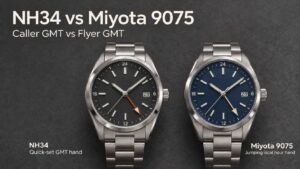
1. Caller GMT vs Flyer GMT in Everyday Use
NH34 caller GMT for tracking time from home
The NH34 lets the wearer adjust the 24-hour GMT hand independently. A buyer in New York who regularly calls a team in London can leave the main hands on New York time and set the GMT hand to London time. This is the logic of a caller GMT. It suits an everyday sports watch whose wearer checks another time zone more often than they change their own.
Miyota 9075 flyer GMT for changing local time
The Miyota 9075 GMT movement lets the wearer move the main local-hour hand independently in one-hour steps. A traveler landing in London can move that hand to local time while the GMT hand keeps New York time and the minutes stay set. The local hour also drives the date as it crosses midnight. Miyota calls this a True GMT, and watch buyers often call it a flyer GMT or traveler GMT.
2. NH34 vs Miyota 9075 Specifications and Design Implications
Side-by-side automatic GMT movement comparison
| Feature | TMI NH34A | Miyota 9075 |
| GMT operation | Caller GMT | Flyer GMT |
| Independently adjustable hand | 24-hour GMT hand | Main 12-hour local hour hand |
| Date adjustment | Dedicated quick-set date | Set via the local hour hand |
| Published movement height | 5.32 mm | 4.92 mm |
| Beat rate | 21,600 vibrations per hour | 28,800 vibrations per hour |
| Published power reserve | More than 41 hours when fully wound | Approximately 42 hours |
| Published movement accuracy | −20 to +40 seconds per day | −10 to +30 seconds per day |
| Winding and time setting | Automatic and manual winding, stop seconds | Automatic and manual winding, stop seconds |
The accuracy figures are the manufacturers’ movement specifications. Agree separately on the test conditions and acceptance range for the assembled watch.
Movement height and finished case thickness
The 9075 is 0.40 mm thinner on paper. If you are developing a slim custom GMT watch, ask for a section drawing of the assembled case before setting a thickness target. The dial, four-hand stack, crystal profile, movement holder, and caseback all use vertical space. The section drawing shows how much of the movement-height difference you can use in the finished watch. Watch design for manufacturability guide
3. What Your Watch Manufacturer Should Check Before Sampling
Dial artwork, date window, and 24-hour scale
Send the factory your dial artwork with the date window, dial center, and intended location of the 24-hour scale marked. A fixed scale can sit on the dial or an inner ring. A rotating 24-hour bezel gives the wearer another way to read an offset. Pick the scale location early so the factory can check that the GMT hand reaches it clearly. For a custom logo watch, review the logo and GMT hand together at actual dial size.
Hand clearances and crown operation
Ask your OEM watch supplier to check hand fittings, clearance between hands, clearance above applied markers, and the gap below the crystal. A design that clears in one hand position may still touch when the hands overlap. On the prototype, test a full rotation, operate each crown position, and check date alignment after adjusting the relevant hand. If you are reusing an existing case, also confirm stem alignment and movement holder fit for the selected caliber.
4. How to Choose for Your Collection and Budget
Choose the feature your buyer will use
For an everyday GMT collection, start with the NH34 if the brief is to track a second time zone without changing the main display. For a travel collection, start with the 9075 if jumping to local time is central to the product. Demonstrate the intended crown operation in a short prototype video before you lock the retail description and user instructions. For an example of an NH34-based design, see Hongliyuan Watch’s HLY1012A automatic GMT watch.
Compare quotes for the complete watch
Ask your custom watch manufacturer to quote both builds against the same brief and order quantity. Request separate lines for movement, caliber-specific hands and dial work, any case changes, sampling, tooling, and assembly testing. For an OEM/ODM watch project, also ask which components can be carried over and which require new drawings. The comparison gives you a better basis for judging unit cost and launch timing than movement prices alone.
Frequently Asked Questions
Is the NH34 a caller GMT or a flyer GMT?
The NH34 is a caller GMT. Its independently adjustable hand is the 24-hour GMT hand.
Is the Miyota 9075 a true GMT?
Yes. Miyota calls the 9075 a True GMT because its main local-hour hand can be adjusted independently while the GMT hand continues to show home time.
How do you change the date on the Miyota 9075?
Move the local hour hand through midnight to change the date. Confirm the forward and backward setting procedure against Miyota’s instructions.
Can the Miyota 9075 fit in a case designed for the NH34?
Treat it as a new fit check. Verify the movement seat, holder, stem alignment, dial feet, hand fittings, and crystal clearance before reusing an NH34 case.
Does either movement require a rotating bezel?
Both can display a second time zone using a fixed 24-hour scale on the dial, inner ring, or bezel. Choose the scale placement according to the intended reading experience.
Which movement should a first-time microbrand choose?
Start with the NH34 for a collection centered on tracking another time zone from home. Start with the 9075 if the watch’s selling point is quick local-time adjustment when traveling. Compare both as finished builds before approving tooling.
Get Your GMT Watch Ready for Sampling
A sketch or reference photo is enough to get started. Send it to Hongliyuan Watch and tell us how you want customers to use the GMT function. We’ll help you choose between the NH34 and 9075, flag dial or case details to resolve before sampling, and tell you what we need to quote your build.
Send Us Your GMT Watch Idea