
Why Good Watch Designs Still Fail in Production
Creating a great-looking watch is only the beginning.
Many watch brands spend months perfecting sketches and renderings, only to discover unexpected manufacturing problems once production begins. Small design decisions can significantly increase tooling costs, delay sampling, or even prevent mass production.
A successful custom watch design balances creativity with manufacturability.
With more than 30 years of experience producing quartz and mechanical watches, Hongliyuan Watch has helped brands around the world turn ideas into reliable products while avoiding unnecessary production risks.
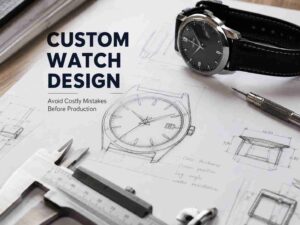
Mistake #1: Designing Without Manufacturing Limits
Many first-time brands design a watch before speaking with a custom watch manufacturer.
This often results in:
- Impossible case structures
- Overly complex components
- Excessive tooling costs
The earlier your manufacturer joins the project, the easier it is to optimize the design.
Mistake #2: Choosing Materials Based Only on Appearance
Different materials require different machining methods.
For example:
- 316L Stainless Steel — durable and cost-effective
- Titanium — lightweight but more difficult to machine
- Bronze — develops a unique patina
- Ceramic — highly scratch-resistant but expensive
A professional custom watch factory can recommend materials that match both your budget and product positioning.
Mistake #3: Ignoring Standard Component Sizes
Many brands create beautiful CAD drawings using dimensions that require completely custom tooling.
Examples include:
- Non-standard crystals
- Custom crown tubes
- Unique gasket sizes
- Special movement holders
Whenever possible, using standardized components reduces cost while improving production efficiency.
Mistake #4: Underestimating Prototype Development
The first sample is rarely the final product.
Professional watch manufacturing often requires several rounds of improvements, including:
- Dial color adjustments
- Hand alignment
- Case finishing
- Bezel fit
- Bracelet tolerances
Allow enough time for refinement before mass production.
Mistake #5: Overlooking Water Resistance Requirements
Many brands decide on water resistance late in the project.
However, achieving:
- 50M
- 100M
- 200M
requires different case structures, crown designs, and testing procedures.
These decisions should be made during the initial custom watch design stage. If you’re developing a dive watch, we also recommend reading our guide “How Much Water Resistance Does a Dive Watch Really Need?” to better understand how water resistance requirements affect case engineering and production planning.
Mistake #6: Forgetting About Assembly Efficiency
Some designs look impressive but dramatically increase assembly time.
Examples include:
- Excessive decorative screws
- Complicated multi-piece cases
- Difficult hand installation
- Complex dial structures
Efficient designs reduce labor costs without sacrificing appearance.
Mistake #7: Choosing the Wrong Movement Too Late
Changing the movement after tooling has begun can require redesigning:
- Case thickness
- Stem position
- Dial feet
- Hands
- Case back
Always finalize the movement before engineering begins.
Mistake #8: Focusing Only on Cost
The cheapest solution often becomes the most expensive.
Poor tolerances, inconsistent finishing, or unreliable suppliers can lead to:
- High defect rates
- Delayed delivery
- Customer complaints
An experienced OEM watch manufacturer helps balance quality and budget.
Mistake #9: Skipping Design for Manufacturability (DFM)
Professional manufacturers review every design before production.
A DFM review identifies:
- Assembly challenges
- Cost-saving opportunities
- Structural improvements
- Quality risks
This process often prevents expensive redesigns later.
Mistake #10: Choosing a Manufacturer Based Only on Price
The right manufacturing partner contributes far more than production capacity.
Look for a custom watch manufacturer with:
- Strong engineering support
- Prototyping experience
- Stable quality control
- Clear communication
- OEM & ODM capabilities
At Hongliyuan Watch, our engineering team works closely with clients throughout every stage of product development, helping brands avoid costly mistakes before production even begins.
Conclusion
A successful custom watch design is not only attractive—it must also be practical to manufacture.
By considering materials, components, assembly, and production processes from the beginning, brands can significantly reduce costs, shorten development time, and improve final product quality.
Working with an experienced partner like Hongliyuan Watch ensures that great ideas become successful products without unnecessary production setbacks.
FAQ About Custom Watch Design
When should I contact a custom watch manufacturer?
As early as possible. Involving your manufacturer during the design phase helps avoid costly engineering changes later.
Can a manufacturer improve my watch design?
Yes. Most professional manufacturers provide Design for Manufacturability (DFM) recommendations to improve production efficiency and reduce costs.
What materials are most commonly used for custom watch cases?
316L stainless steel remains the most popular because it offers an excellent balance of durability, appearance, and manufacturing cost.
How long does custom watch development usually take?
Including design, sampling, revisions, and production, most projects take approximately three to six months depending on complexity.
Can I manufacture watches with my own logo?
Yes. A professional private label watch or OEM manufacturer can customize the dial, case back, crown, buckle, packaging, and other branding elements.
How do I choose the right custom watch factory?
Choose a factory with proven engineering experience, transparent communication, reliable quality control, and a strong track record in OEM and ODM watch manufacturing.